



Index investing is one of the simplest, lowest-cost, and most effective ways for Canadians to build long-term wealth. Instead of trying to pick winning stocks or time the market, you buy funds that track broad market indexes—owning a slice of hundreds or thousands of companies at once. Over time, this passive approach has beaten the majority of actively managed funds after fees, while requiring far less effort and cost.
This guide covers everything you need: what index investing is, why it works especially well in Canada, the best account types, popular low-cost ETFs, how to build a portfolio, tax considerations, and a practical step-by-step plan to get started.
What Is Index Investing?
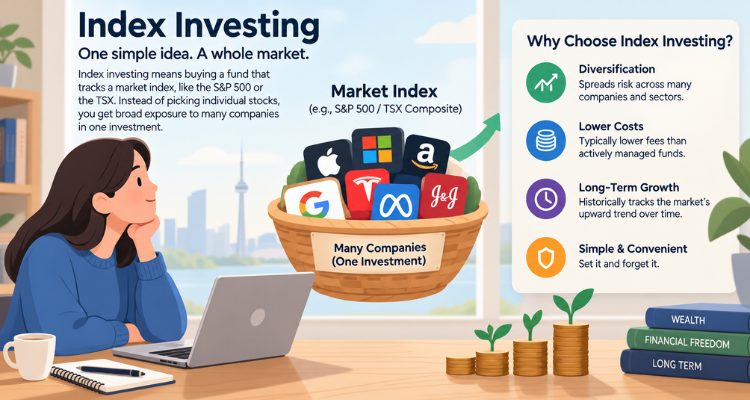
An index is a benchmark that measures the performance of a group of securities. Examples include the S&P/TSX Capped Composite (broad Canadian stocks), the S&P 500 (500 largest U.S. companies), and global indexes covering developed and emerging markets.
An index fund (usually an exchange-traded fund, or ETF) holds the same securities in roughly the same proportions as the index it tracks. Its goal is to match the index’s return, not beat it. Because the fund simply follows rules rather than employing expensive stock-pickers, fees stay very low—often 0.05% to 0.25% per year (the Management Expense Ratio, or MER).
You can also use traditional index mutual funds (such as TD’s e-Series), but ETFs generally offer lower costs and greater flexibility for most DIY investors.
Why Index Investing Works So Well for Canadians
- Ultra-low costs compound powerfully. A 2% active mutual fund fee versus a 0.20% ETF fee on a $100,000 portfolio is a $1,800 difference every year. Over decades, that gap can amount to tens or hundreds of thousands of dollars.
- Built-in diversification. One ETF can hold thousands of stocks across Canada, the U.S., international markets, and bonds, reducing the risk of any single company or sector wiping out your returns.
- Evidence-based performance. Most active managers underperform their benchmarks after fees over longer periods. Indexing captures the market return with minimal drag.
- Simplicity and discipline. You avoid constant research, trading, and emotional decisions. “Buy, hold, and rebalance occasionally” is the strategy.
- Tax-advantaged accounts make it even better. Canada’s TFSA, RRSP, and FHSA turn already-efficient indexing into a highly tax-efficient engine.
Warren Buffett and many other long-term investors have publicly endorsed low-cost index funds for the average person.
The Best Accounts for Index Investing in Canada
Where you hold your investments matters as much as what you hold.
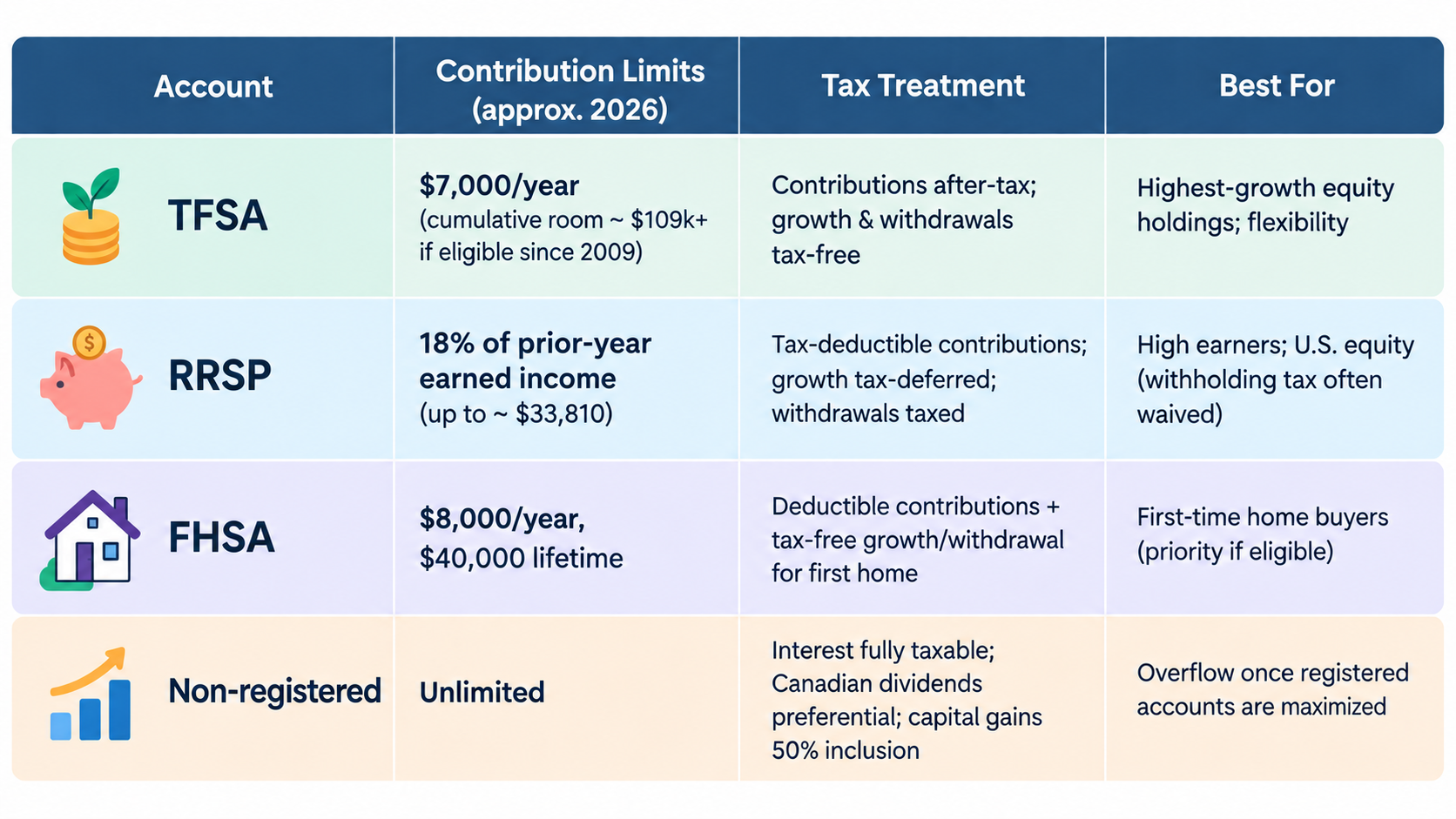 Priority order for most people: Maximize FHSA (if eligible) → TFSA → RRSP (depending on tax bracket and goals) → non-registered.
Asset location tip: Hold bonds and interest-paying investments in RRSPs/TFSAs (to shelter fully taxable interest). U.S. dividend-paying ETFs are often more efficient in an RRSP because of the Canada-U.S. tax treaty. Canadian equity and growth assets shine in a TFSA.
Building Your Portfolio: Keep It Simple
You have two main approaches.
1. One-Fund Solution (Recommended for Most People)
Asset-allocation ETFs hold a complete mix of stocks and bonds and rebalance automatically. Choose based on your time horizon and risk tolerance:
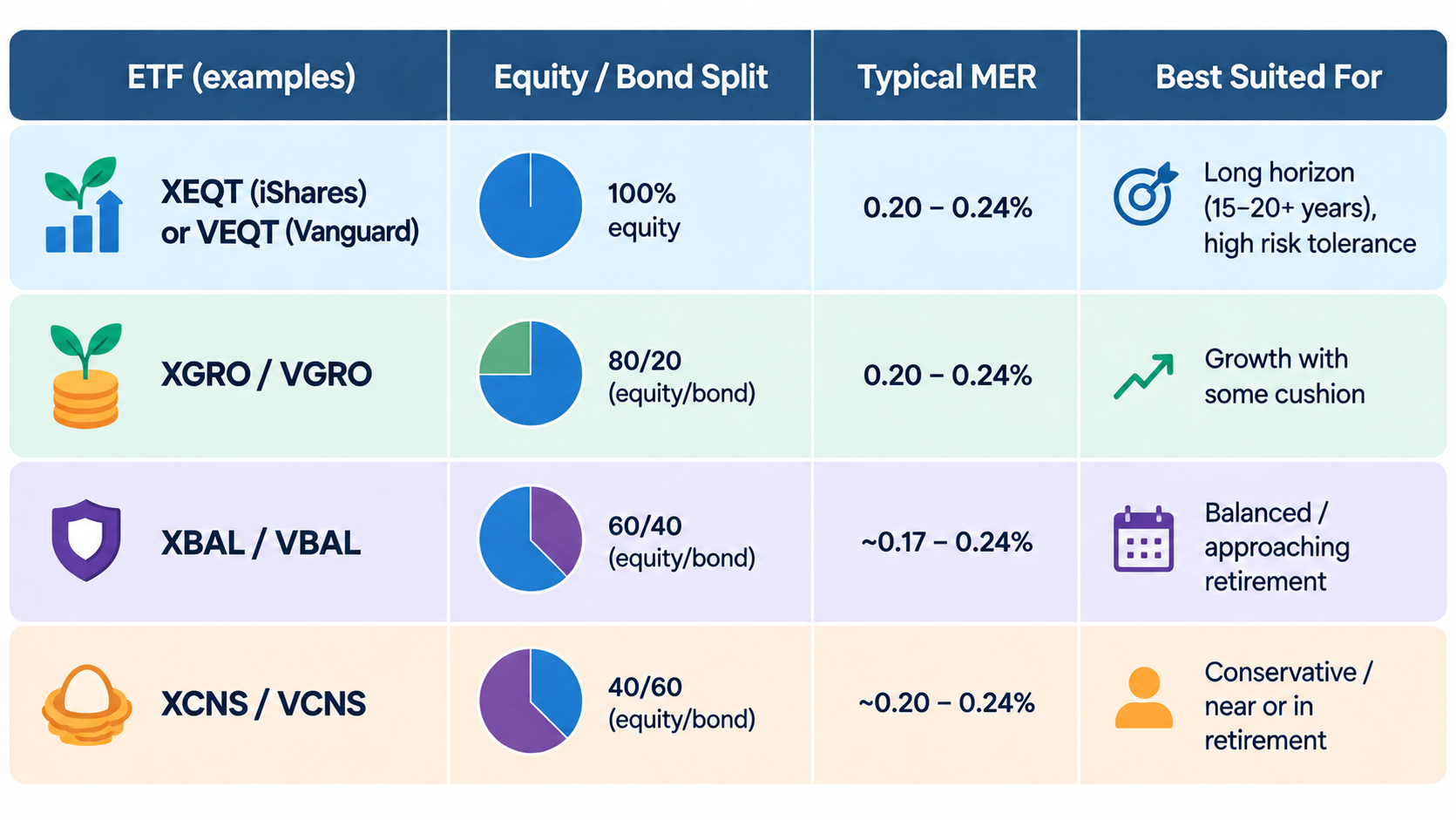
These funds typically hold ~25–30% Canadian equities (home bias), with the rest in U.S., international developed, and emerging markets, plus bonds. Differences between iShares and Vanguard versions are small; pick one and stick with it.
2. Two- or Three-ETF Portfolio (More Control)
Example balanced mix:
- Canadian equity: XIC or VCN (MER ~0.05–0.06%)
- Global equity (ex-Canada): XAW or VXC (MER ~0.20–0.22%)
- Canadian bonds: ZAG or VAB (MER ~0.09%)
Rebalance once a year or when allocations drift more than 5%.
Popular individual building blocks:
- Canadian broad market: XIC, VCN, ZCN
- S&P 500: VFV, ZSP, XUS
- Global ex-Canada: XAW, VXC
- Bonds: ZAG, VAB
How to Get Started in 5 Steps
- Open a self-directed brokerage account. Popular low-cost options include Wealthsimple Trade, Questrade, and others that offer commission-free trading on many Canadian-listed ETFs. You can open TFSA, RRSP, FHSA, or non-registered accounts online.
- Decide your asset allocation. Consider your age, goals, time horizon, and how you react to market drops. A common rule of thumb is roughly “100 minus your age” in equities, adjusted for personal comfort. Younger investors often lean toward 80–100% equity.
- Choose your funds. Start with a single all-in-one ETF if you want maximum simplicity. Research current MERs and holdings on the provider’s website (iShares, Vanguard, BMO).
- Fund the account and buy. Transfer money via e-transfer or linked bank account, then place a market or limit order for the ETF ticker. Many platforms support fractional shares.
- Contribute regularly and stay the course. Set up automatic contributions if possible. Review once a year, rebalance if needed, and ignore short-term noise. History shows that time in the market beats timing the market.
Risks and Realistic Expectations
Index investing does not eliminate risk. Markets can (and do) drop 20–50% in bad years. Your portfolio will fluctuate with the underlying indexes. Currency risk exists with unhedged foreign holdings, and Canadian markets are concentrated in financials, energy, and materials.
Past performance is not a guarantee of future results. Expected long-term equity returns are typically in the mid-to-high single digits annually after inflation, but sequences of returns matter. Bonds provide ballast but lower overall expected growth.
Avoid common pitfalls: chasing hot sectors, panic-selling during downturns, or overcomplicating with too many funds.
Final Thoughts
Index investing removes the need to be a stock-picking genius. By focusing on low costs, broad diversification, tax-efficient accounts, and consistent contributions, most Canadians can build substantial wealth over decades with minimal ongoing effort.
Start small if needed—many platforms have no minimums. Open an account, buy a suitable all-in-one ETF such as XEQT or VEQT in a TFSA, and let compounding do the heavy lifting. The best time to begin was years ago; the second-best time is today.
This is educational information, not personalized financial advice. Consider your own situation, or consult a licensed advisor if you have complex needs. Markets change, contribution limits update annually, and MERs can shift slightly—always verify current details before investing.