



Life insurance is one of the most important financial tools available to Canadian families, yet many people delay buying it or choose the wrong type. A solid policy delivers a tax-free lump-sum payment to your beneficiaries if you die, helping them cover the mortgage, replace lost income, pay debts, fund education, and handle final expenses.
This guide walks you through everything you need to know to buy the right coverage in Canada—types of policies, how much you need, costs, the buying process, and practical tips.
Why Canadians Need Life Insurance
According to the Canadian Life and Health Insurance Association (CLHIA), tens of millions of Canadians already hold life insurance. The most common reasons include:
- Protecting a spouse or partner who depends on your income
- Covering a mortgage or other large debts
- Funding children’s education or childcare
- Providing final expense and estate liquidity
- Supporting business continuity (key person or buy-sell agreements)
Death benefits paid to a named beneficiary are generally received tax-free in Canada. This makes life insurance particularly efficient for family protection and estate planning.
Types of Life Insurance Available in Canada
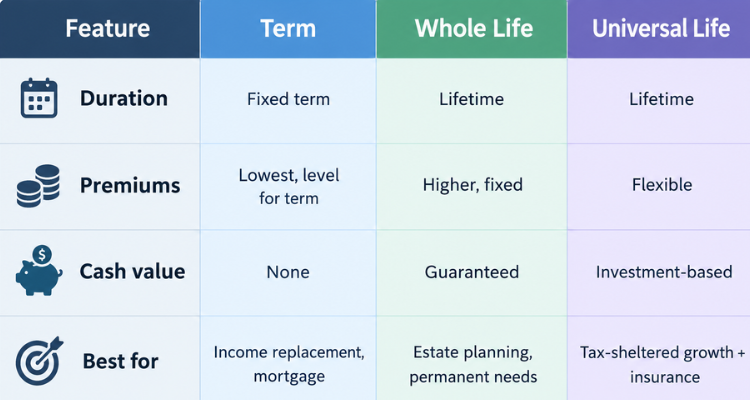
Canadian life insurance falls into two main categories: term and permanent.
Term Life Insurance
Provides coverage for a set period (commonly 10, 20, or 30 years). If you die during the term, your beneficiaries receive the death benefit. If you outlive the term, coverage ends (though many policies are renewable or convertible to permanent coverage without a new medical exam).
- Lowest cost
- No cash value
- Ideal for temporary needs such as raising children or paying off a mortgage
- Most popular choice for Canadian families
Permanent Life Insurance
Lasts your entire life (as long as premiums are paid) and usually builds cash value that grows on a tax-deferred basis.
- Whole life: Fixed premiums, guaranteed cash value growth, and often participating dividends. Best for lifelong needs and estate planning.
- Universal life: Flexible premiums and an investment component you can direct. More complex and suitable for people who have already maximized RRSPs and TFSAs.
- Term 100: Permanent coverage with level premiums until age 100 (after which premiums may stop). Limited or no cash value.
Other options include simplified-issue and guaranteed-issue policies (easier approval, higher premiums, lower coverage limits) and group coverage through employers (convenient but usually limited and not portable).
How Much Life Insurance Do You Need?
There is no single correct number, but two practical approaches work well for most Canadians.
1. Rule of thumb
10–15 times your annual gross income is a common starting point.
2. DIME method (widely recommended by Canadian planners)
- Debt: Non-mortgage debts (credit cards, car loans, lines of credit, student loans)
- Income replacement: Annual income × number of years of support needed (often 10–15)
- Mortgage: Remaining balance
- Education: Estimated costs for children (often $80,000–$120,000 per child for post-secondary)
Subtract existing coverage (employer group life, other policies) and liquid assets. Add a buffer for final expenses (typically $10,000–$20,000).
Example: $90,000 income, $450,000 mortgage, $25,000 other debts, two children needing $100,000 education funding each, $80,000 savings, and $90,000 employer coverage.
Rough need: (90,000 × 10) + 450,000 + 25,000 + 200,000 − 80,000 − 90,000 ≈ $1.4 million.
Coverage needs change with life stages. Young singles may need little more than debt and final-expense coverage. Families with young children and mortgages often need $750,000–$2 million+. Near retirement, needs often drop to final expenses and estate taxes.
What Affects the Cost of Life Insurance?
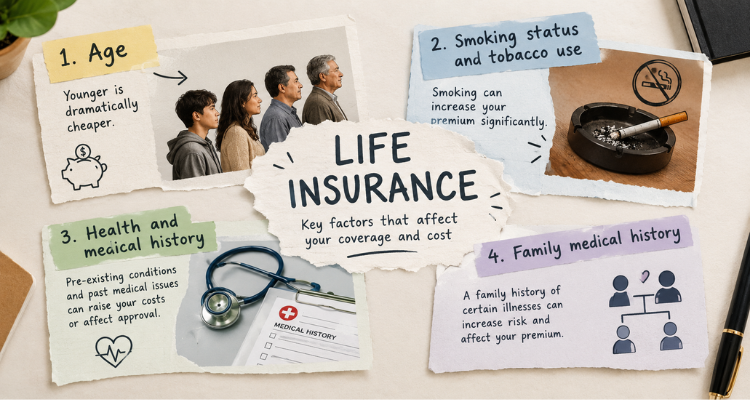
Premiums are based primarily on:
- Age (younger is dramatically cheaper)
- Sex at birth
- Smoking status and tobacco use
- Health and medical history
- Family medical history
- Lifestyle (high-risk hobbies or occupations)
- Coverage amount and term length
- Type of policy and underwriting path (fully underwritten vs. no-medical)
A healthy non-smoking 30-year-old can often secure $500,000 of 20-year term coverage for roughly $25–$40 per month. The same coverage at age 50 costs several times more. Fully underwritten policies (with medical questions or exams) are usually the least expensive if you qualify.
Step-by-Step Guide to Buying Life Insurance in Canada
- Clarify your goals and calculate coverage
Use the DIME method or a reputable online calculator, then adjust for your situation. - Decide on term vs. permanent (or a combination)
Most Canadian families start with affordable term coverage matched to the years of highest need (e.g., until the mortgage is paid or children are independent). Add permanent coverage later for estate or lifelong needs if desired. - Compare quotes from multiple sources
Use independent brokers or online comparison platforms that shop multiple insurers (Manulife, Sun Life, Canada Life, RBC Insurance, Desjardins, iA Financial, Empire Life, and others). Direct online providers and bank insurers are also options. Look at more than just price—check conversion rights, rider options, and financial strength (most major Canadian insurers are Assuris members, which protects policyholders if a company fails). - Choose the application path
Fully underwritten: Best rates, may require a medical exam or paramedical.
Simplified / no-medical: Faster, higher premiums, lower maximum coverage.
Guaranteed issue: No health questions, highest cost, limited amounts (often used for final expenses). - Complete the application and underwriting
Answer health, lifestyle, and financial questions accurately. Misrepresentation can void a claim. - Review the offer and free-look period
Most policies include a 10-day (sometimes longer) free-look period during which you can cancel for a full refund. - Name beneficiaries carefully and keep them updated
Name primary and contingent beneficiaries. Review after major life events (marriage, divorce, birth of a child, etc.). - Set up premium payments and review periodically
Annual payments sometimes cost less than monthly. Reassess coverage every few years or after major life changes.
Common Mistakes to Avoid
- Waiting too long (premiums rise and health can deteriorate)
- Buying only through an employer and assuming it is enough (group coverage is often limited and ends if you leave the job)
- Choosing permanent insurance when term would meet temporary needs more affordably
- Underinsuring (or overinsuring beyond what you can comfortably afford)
- Failing to name or update beneficiaries
- Ignoring conversion options on term policies
- Focusing solely on the lowest premium without checking the insurer’s strength or policy features4

Practical Tips for Getting the Right Policy
- Buy when you are young and healthy, premiums are lowest and insurability is highest between roughly ages 25 and 35.
- Prefer fully underwritten coverage if your health is good; the savings over time are significant.
- Consider riders only if they add real value (e.g., child coverage, critical illness, or waiver of premium).
- Work with a licensed advisor or independent broker if your situation is complex (high net worth, health issues, business needs, or estate planning).
- Check that the insurer is a member of Assuris for policyholder protection.
- Keep existing policies in force until new coverage is fully issued and in force.
- Review your policy every 3–5 years or after major life events.
Final Thoughts
The “proper” life insurance for a Canadian is the coverage that protects the people who depend on you, fits your budget, and matches the length of time those needs exist. For most families, that starts with solid term life insurance calculated using a needs-based approach such as DIME. Permanent policies play an important role for lifelong protection and estate planning.
Start by estimating your coverage need, then gather quotes from several reputable sources. The process is straightforward, the protection is valuable, and the peace of mind is lasting. If your situation involves business ownership, complex estates, or health concerns, speak with a licensed life insurance advisor who can provide personalized guidance.
Buying the right life insurance is one of the most responsible financial decisions you can make for the people you care about.