

Protecting your income is one of the most important financial decisions you can make. In Canada, government programs and employer benefits provide a basic safety net, but they are rarely enough to maintain your lifestyle if illness or injury stops you from working. Disability insurance and critical illness insurance fill different gaps. Understanding both—and buying the right combination—can prevent financial hardship.
Why These Coverages Matter
Roughly one in three working Canadians will experience a disability lasting 90 days or longer before age 65. Leading causes of long-term claims include musculoskeletal issues (back and neck problems), mental health conditions, and cancer—not just dramatic accidents.
Government supports are limited:
- EI sickness benefits: Up to 26 weeks at 55% of insurable earnings, maximum $729 per week in 2026.
- CPP disability: Maximum $1,741.20 per month in 2026 (average for new beneficiaries is lower). It requires a “severe and prolonged” disability that prevents any substantially gainful work.
Employer group plans help many people, but they are often temporary, portable only while you stay employed, and may switch from “own occupation” to “any occupation” after two years. Individual policies you own give you control, portability, and stronger definitions.
Disability Insurance vs. Critical Illness Insurance
These products solve different problems and work best together.
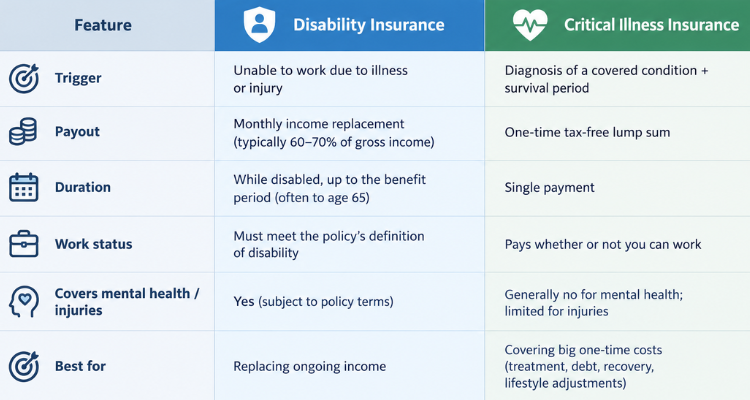
Disability insurance is income protection. It pays a monthly benefit after a waiting period if you cannot perform the duties of your occupation (or any occupation, depending on the definition).
Critical illness insurance pays a lump sum (often $25,000–$2 million) after you are diagnosed with a covered condition (cancer, heart attack, stroke, and usually 20–30+ others) and survive the waiting period (commonly 30 days). You can use the money however you wish.
Most working Canadians benefit from both. If you can only afford one, prioritize disability insurance because it covers a much wider range of situations that stop you from earning an income.
Disability Insurance: What to Look For
1. Definition of disability (the most important clause)
- Own occupation: Pays if you cannot do your specific job, even if you could do something else. Strongest protection, especially valuable for professionals and specialists.
- Regular occupation: Similar but sometimes slightly broader.
- Any occupation: Pays only if you cannot do any job for which you are reasonably suited. Weaker and more common in group plans after the first 24 months.
Prefer policies that keep the own-occupation definition for the full benefit period, or at least for the first two years.
2. Benefit amount
Aim for 60–70% of gross income. Because personally paid individual policy benefits are usually tax-free, this roughly replaces your take-home pay. Insurers cap the percentage and set maximum monthly benefits.
3. Waiting (elimination) period
Common options: 30, 60, 90, or 120 days. Longer waiting periods lower premiums. Match it to your emergency savings or short-term coverage (employer STD + EI).
4. Benefit period
Prefer benefits to age 65 (or 67/70). Shorter periods (2 or 5 years) leave you exposed to long-term disabilities.
5. Policy type
Non-cancellable and guaranteed renewable: Insurer cannot cancel the policy or raise your individual premiums as long as you pay. Best.
Guaranteed renewable: Must renew, but premiums can increase for the class.
6. Key riders and features
- Residual/partial disability benefits (pays a reduced amount if you return to work part-time).
- Cost-of-living adjustment (COLA) to protect against inflation during a long claim.
- Future increase option / guaranteed insurability (raise coverage without new medical evidence as income grows).
- Waiver of premium while on claim.
- Mental health and musculoskeletal limitations (some policies limit these to 24 months—read carefully).
Group vs. individual
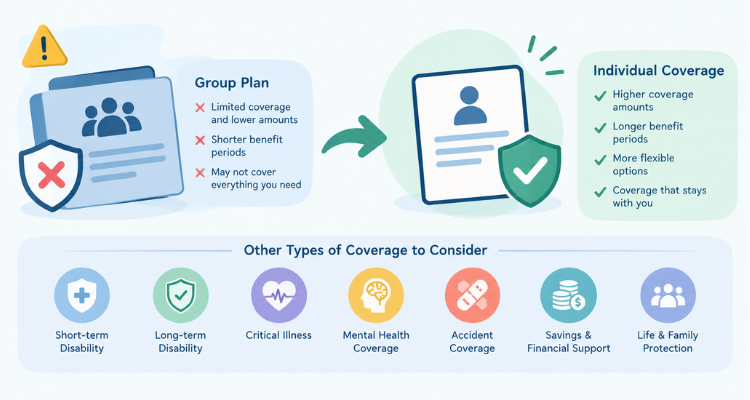
Check your employer plan first (waiting periods, definition, maximum benefit, tax treatment, and what happens if you leave the job). Many people buy individual coverage to top up group benefits or replace them if self-employed or job-hopping. Individual policies you own stay with you.
Cost
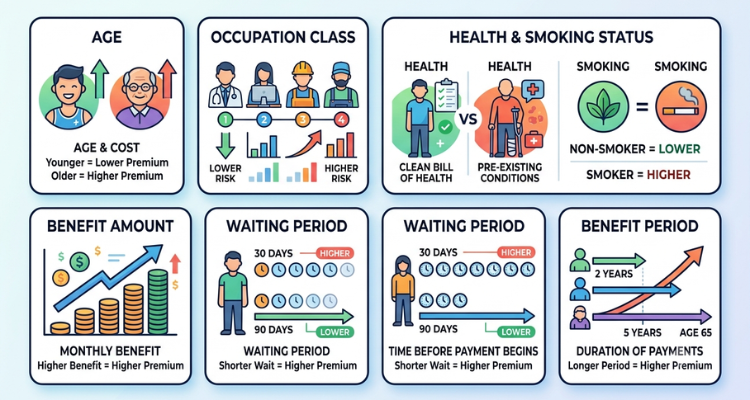
Typically, 1–3% of annual income. Factors: age, occupation class, health, smoking status, benefit amount, waiting period, and benefit period. Buying younger and healthier locks in lower rates and better terms.
Critical Illness Insurance: What to Look For
1. Covered conditions and definitions
Basic plans often cover cancer, heart attack, and stroke (these account for the large majority of claims). Comprehensive plans cover 25–40+ conditions. More important than the raw number is the quality of the definitions—especially for cancer (which early-stage cancers are excluded) and heart attack.
2. Survival period
Usually 30 days after diagnosis. Confirm exact wording.
3. Early-stage / partial benefits
Some policies pay a smaller percentage for early-stage cancers or less severe cardiac conditions without reducing the main benefit.
4. Coverage amount
Common starting points: 1–2 years of after-tax income, or enough to cover your mortgage/debt plus recovery costs. Policies typically range from $10,000 to $1–2 million.
5. Term length and premium structure
Term (10, 20, 25, 30 years) or coverage to age 65/75/100. Level premiums that do not increase with age are preferable for longer-term needs. Return-of-premium riders (refund premiums if you never claim) add cost but appeal to some buyers.
6. Exclusions and waiting periods
Cancer diagnosed in the first 90 days is often excluded. Pre-existing conditions may be excluded or limited. Read the policy carefully.

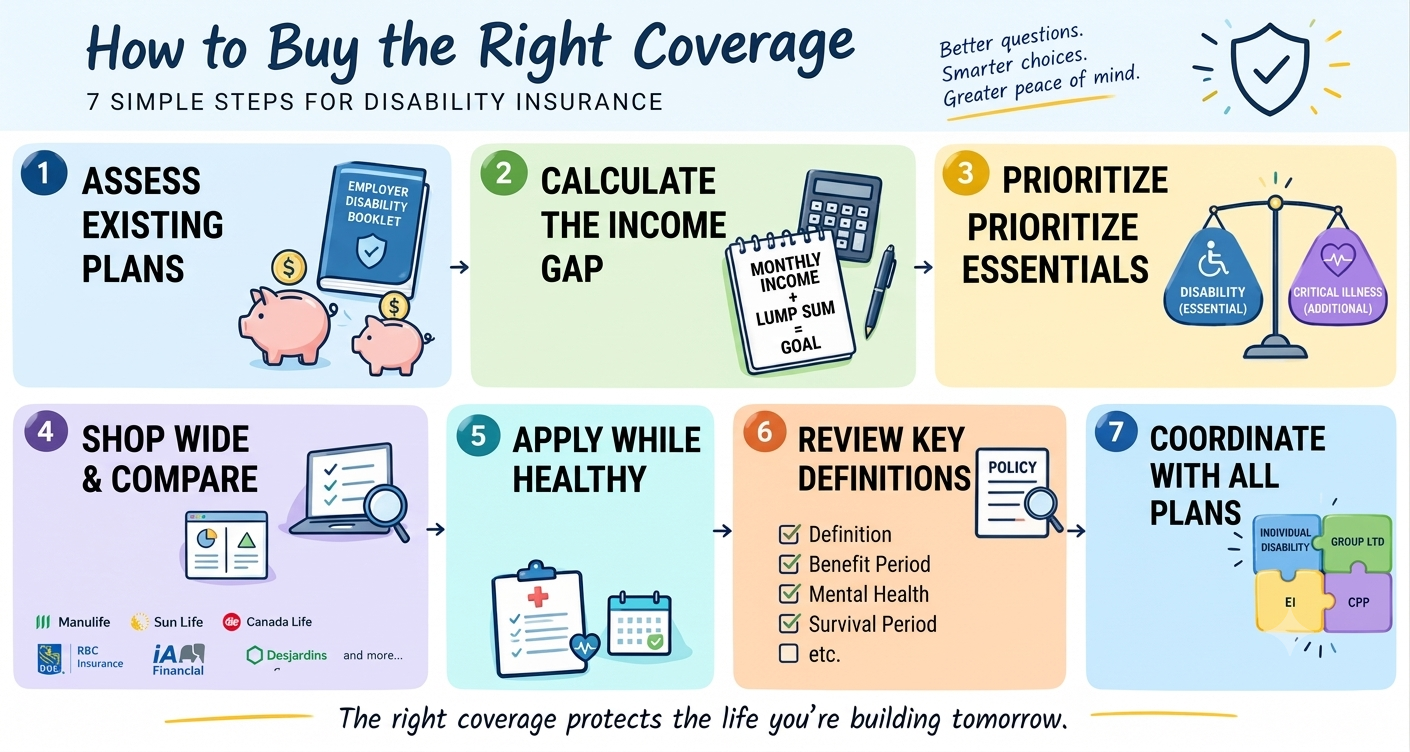
How to Buy the Right Coverage: Step-by-Step
1. Assess your existing protection
Employer short-term and long-term disability (get the Before relying on private disability insurance, review your employer’s short- and long-term disability coverage and get a copy of the booklet. Also check your EI eligibility and maximum benefits, CPP/QPP disability benefits, any association or group plans you may qualify for, and your available emergency savings.
2. Calculate the gap
Decide how much monthly income you need to replace and what lump sum would meaningfully help with a major diagnosis.
3. Decide on priorities
Disability first for most people. Add critical illness if budget allows, especially if you have dependents, a mortgage, or limited savings.
4. Shop smart
Work with a licensed independent advisor or broker who can access multiple insurers (Manulife, Sun Life, Canada Life, RBC Insurance, iA Financial, Desjardins, and others). Compare definitions, not just premiums. Get illustrations for different waiting periods and benefit amounts.
5. Apply while healthy
Underwriting is based on current health, occupation, and income. Delaying can mean higher premiums or exclusions.
6. Review the contract
Confirm definition of disability, benefit period, residual benefits, mental-health limitations, survival period, covered conditions, and tax treatment of benefits (personally paid disability benefits are generally tax-free).
7. Coordinate coverages
Understand how individual disability benefits interact with group LTD, EI, and CPP (offsets are common). Critical illness usually pays independently.
Common Mistakes to Avoid
- Relying only on group coverage or government programs.
- Choosing the cheapest policy without checking the definition of disability.
- Buying a short benefit period.
- Ignoring residual/partial disability benefits.
- Waiting until a health issue appears.
- Assuming critical illness covers mental health or any injury.
- Not reviewing coverage after major life changes (new job, higher income, mortgage, children).
Final Thoughts
Disability insurance protects your ability to earn a living. Critical illness insurance gives you flexible capital when a serious diagnosis arrives. Together they form a strong living-benefits safety net that government programs and most employer plans cannot fully replace.
Start by reviewing what you already have through work, then speak with a licensed advisor who specializes in disability and critical illness coverage. The right policy bought while you are healthy is far more valuable—and affordable—than scrambling after a diagnosis or injury. Your future self will thank you.